Wednesday, February 19, 2014

Undiyo


Come winter and all the Gujarati women get busy with preparation of one seasonal favorite “Undiyo or Oondiyo”.

Undiyo is one of the favorite dishes in our house and we used to wait till the sweet shops put on boards saying “Undiyo Available”.

I always thought it’s not in my capacity to prepare this dish, but thanks to my friend Vishakha Mehta,who gave me this recipe, which though time consuming, but is still worth the effort.

I never thought that I’ll be able to prepare this tough dish. Though when I prepared it for first time, it was not that perfect, as I did get heath conscious and added less oil. But then we do learn from our mistakes.

So here is the recipe of one of my favorite winter delicacy.

Ingredients:

Tuvar n Surti papdi
100 gms small baby potatoes
100 gms sweet potato
100 gms purple yam
100 gms small brinjal
100 gms suran or yam
2 medium size raw bananas
2 small not so ripe elachi bananas
150 gms tuvar
150 gms surati papdi

For green masala:

250 gms shelled peas
1 bunch of coriander leaves
Green chillies 5-6
1 bunch of green garlic with leaves
Ginger
1 cup grated coconut
1 whole garlic
1 tablespoon red chilli powder
1 tablespoon dania powder
1 tablespoon jeera powder
1 teaspoon hing / asafoetida
1 teaspoon owa/ajwain
Salt to taste
1 teaspoon sugar
1 table spoon oil

Ingredients for methi muthiya

1 bunch of methi/fenugreek leaves
Besan/ chick pea flour
2 table spoon jowar flour
1 teaspoon hing
1 teaspoon haldi powder
2 teaspoon red chilli powder
Salt to taste
1 teaspoon owa
2-3 table spoon oil

1 litre oil
Salt to taste

Little grated coconut and coriander leaves for garnishing

Procedure

1.    Firstly wash all the vegetables and pat dry.
2.    Destring surati papdi, don’t throw away the outer shells, but remove the seeds from the shells.
3.    In same way remove seeds from tuvar but discard the shells.
4.   Clean and keep all the vegetables aside.


How to prepare methi muthiyas

Methi Muthiyas
1.    Clean the methi leaves and roughly chop them.
2.    Add all the ingredients given for its preparation except besan.
3.    Add besan bit by bit till chapatti like dough is formed.
4.   Adjust salt and keep aside for 5-10 min.
5.    Make small balls and deep fry them and remove them on tissue paper to drain out excess oil and keep them aside.

How to prepare green paste

1.    Keep aside some green leaves of green garlic.
2.    Coarsely grind all the other ingredients given for green paste.
3.    Adjust salt and keep aside.
4.   DON’T add water while grinding the paste.


How to prepare Undiyo

1.    Cut all the potato, yams, and bananas into large cubes with a slit in between for the stuffing.
2.    If baby potatoes are big, cut them into half and then make a slit or keep them whole with a slit in middle.
3.    For small brinjals don’t cut the stem. Make cross slit on the broader end and fill the stuffing as we usually do for stuffed brinjals.
4.   Stuff the green masala in all the veggies.
5.    Apply some masala to the papdi’s and tuvar also.


Purple Yam, sweet potato, raw banana and potato
Brinjal n Elachi banana


6.   Pressure cook potatoes, yam, raw banana, papdi and tuvar upto 2 whistles in a covered vessel so that water doesn’t enter the veggies.
7.    DON’T pressure cook brinjals and small banana.
8.   In a thick bottom vessel or non-stick kadai pour ½ litre oil (yes, this recipe is not for diet conscious people or for faint hearted ones also as it consumes lots of oil).
9.   Sauté remaining green masala along with green garlic leaves till the raw smell goes away.


10. Add all the veggies (the pre-boiled and brinjals, small bananas) and with light hand mix and cover them with this mixture.
11.  Lower the gas to minimum and cover the vessel and allow to cook on low heat.
12. Keep checking in between as it tends to stick and burn at bottom.
13. Keep cooking till all the veggies are cooked.
14. Adjust the salt.
15. Add the methi muthiyas to the mixture and let this cook for few more minutes.
16. Don’t keep stirring again and again as the vegetable will become soggy.
17. Close the gas and serve hot garnished with little grated coconut and coriander leaves with hot piping puris or chapattis.


Note :

1.    In ingredients I have written 1 litre oil, whereas in procedure I have used ½ litre. While cooking if you feel the cooking is drying up oil heat little oil and add to mixture.
2.     It does take some time for preparation but I promise that after slogging of 3-4 hours in kitchen when your family praises you makes you forget all the slogging.
3.    While trying for first time, don’t go for making in large quantities. Try doing with smaller portions of vegetables, in case if something goes wrong not much will be waste.


Happy cooking and Happy Eating…
Enjoy the winter foods.

DMCA.com

Thursday, November 14, 2013

Mande

Come Diwali and all ladies get busy with cleaning of house and planning of Diwali snacks or Faral as it’s called in Marathi.

        My Aayi, who makes excellent sweets taught me this recipe, which initially looks tricky to make, but is yummy and different.

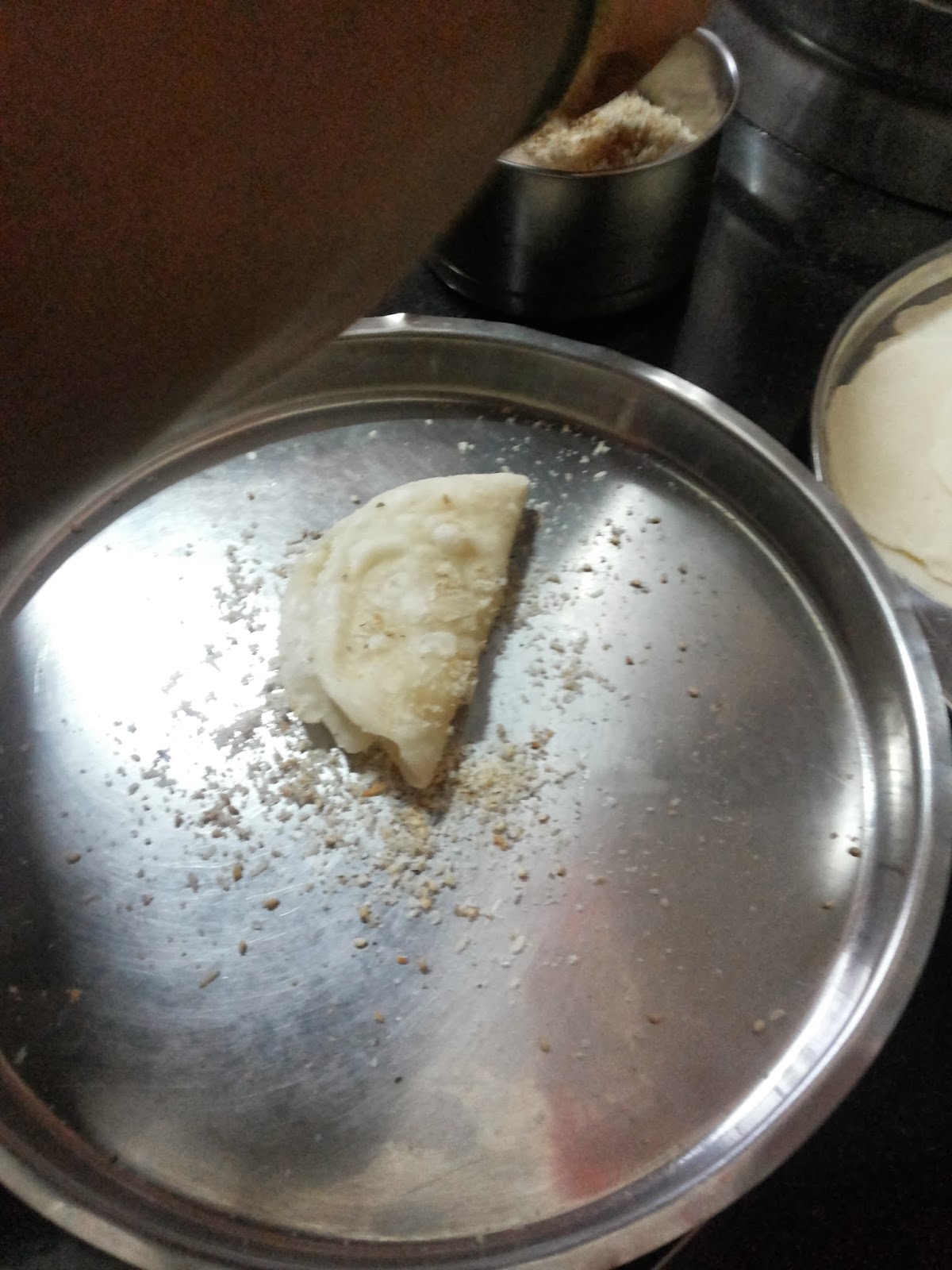
        It’s called Mande. It’s basically a puri made from maida covered with fine mixture of grated and roasted coconut, sugar and sesame seeds.

       
Ingredients

For the puri:

¼ kg Maida
2 tablespoon melted ghee
Salt to taste
Water or milk to make dough

For stuffing:

1 whole dry coconut or copra
Powder sugar according to your taste
2 tablespoon roasted til (sesame seeds)
2 teaspoon elachi powder

Oil for frying


Firstly prepare the stuffing:

1.    Finely grate the dry coconut.
2.    Dry roast it on low heat.
3.    Once cooled add sugar, roasted til and elachi powder and keep aside.


For Puri:

1.    Make dough from the ingredients of puri. Heat the ghee before adding to the dough.
2.    The dough shouldn’t be very soft or very hard. It should be normal dough like chapatti dough.
3.    Keep it aside,covered to rest for 15-20 mins.


How to assemble:

1.    Divide the dough into 20 equal balls.
2.    Roll out puris from the dough and remember to prick it with fork, as we don’t want these to puff while frying.


3.    After you have rolled out all the puris, heat the oil.
4.   Till oil get heated up, in a plate spread little bit of coconut sugar mixture.


5.    Once the oil gets hot, lower the flame and fry the 1st puri.
6.   When the puri is fried on both sides, drain the excess oil and place it on the plate with the coconut mixture.
7.    Sprinkle some of the mixture on the puri and fold it into half.
8.   Again sprinkle some more mixture and fold into quarter.
9.This folding and sprinkling of coconut mixture has to be done immediately after frying when the puris are soft.
10. Once it gets cool, it becomes hard and crisp.
11.  Repeat this process for rest of the puris.

12. Allow it to cool and store into airtight container.

Note : 

You can add milk while making dough, but then it does stay fresh for long duration. But if water is added to dough it can stay for 10 - 15 days.


I have written and submitted this recipe for KitchenAid® India: Diwali Recipe Contest and Giveaway


DMCA.com

Wednesday, October 2, 2013

Manni

          When my daughter’s school decided to hold a food festival last weekend it set me thinking “What should I make?”…

          So I decided to make Manni or rice halwa as it is called, another Manglorean sweet dish. The traditional recipe includes soaking of rice and then grinding it into a fine paste, then mixing with coconut milk and jaggery and then cooking it till it forms a lump…

           But then I decided to make the shortcut version which was taught to me by my Aayi…

          So here are the ingredients and recipe for Rice and Moongdal Halwa or sweet kichidi as it is called…

Ingredients

1 cup rice (uncooked)
1 cup yellow Moongdal
1 grated coconut (only white part)
1 ½ cup gul / jaggery
Pinch of salt
Elachi and nutmeg (jaiphal) powder
Ghee
5 cups water

1.    Wash and soak rice and dal for ½ hour.
2.    Drain the water, add 5 cups water and pressure cook till 3 whistles.
3.    In a thick bottom kadai, first melt the gul.
4.   Then add the coconut gratings, along with pinch of salt.
5.    Mix well.
6.   Then add cooked rice and dal mixture, once the gul has melted fully.
7.    Add elachi and nutmeg powder, 1 tablespoon ghee.
8.   Some add saffron for additional flavour and aroma.
9.   Keep stirring so as the mixture doesn’t stick to the bottom.
10. Keep stirring till it forms a lump.
11.  Pour the mixture in to a greased plated.
12. Flatten it by tapping it with a greased end of inverted glass or cup.
13. Allow it to cool.
14. Then cut it into diamond or any required shapes and decorate it with fried cashew or kismis or serve as it is.


Enjoy it hot or cold. Both taste best.


Note :

1.    You can make variations in this by using either only rice or a mix of rice and channa dal or rice or whole green moong.
2.    If you find it hard to keep stirring to form a lump, when the rice and gul is mixed properly, close the gas and you can serve it as you serve semolina halwa in a plate.
3.    Another variation is, instead of rice use ragi or nachani flour and mix it with coconut milk and jaggery.
4.   If you are using whole moong or channa dal soak it for upto 1 hour and take upto 4-5 whistles.


DMCA.com

Thursday, September 5, 2013

Corn onion pakoda

I know all reading this recipe will curse me saying “she is posting this recipe now when rains have gone”… So first I apologize for delay… Had been busy so couldn’t upload…

          So here is a simple snack for evening tea… A little variation from usual Onion bhaji…

Ingredients

1 cup American corn
1 cup sliced onions
1 medium boiled and mashed potato
2 finely chopped green chillies
Finely chopped coriander leaves
Salt to taste
Red chilli powder to taste
Oil for frying
2 tablespoon rice flour
1-2 cups besan or chickpea flour

1.    Roughly crush American corn in mixer. Don’t make a fine paste.
2.    In a bowl add the crushed corn, onion, mashed potatoes, green chillies, coriander leaves, red chilli powder, rice flour, salt to taste.
3.    Mix all ingredients very nicely. Don’t add water.
4.   Now add besan 1 tablespoon at a time to make a thick batter just like we make for onion bhajis. If required now you can add little water.
5.    After you get the required consistency, adjust salt & red chilli according to your taste.
6.     Heat the oil in a kadai.
7.    When the oil gets hot, lower the gas flame and with help of a wet spoon pour dollops of the above batter in hot oil.
8.   Fry till golden brown.
9.   Remove the pakodas and spread them over kitchen towel or tissue papers to drain excess oil.

10. Serve hot with ketchup or pudina chutney and hot piping ginger tea.


Note:

          In view of recent price hike of onions, you can omit onions for this recipe till the price of onions comes down… or you can add only 1 small finely diced onion, just to bring in the sweetness and crunchiness…

          Or else another option is, whenever you feel like having “kanda bhajiya” but price tag of onions don’t allow you, make this pakodas and satisfy your desire J


 Enjoy Cooking J


DMCA.com

Thursday, August 29, 2013

Sepu Bhaji Dosa

This  is a healthy breakfast item…

          Sepu bhaji as its commonly known also known as Dill in English is rich in Iron…It is said that eating this leafy vegetable, while a woman is lactating helps in increase of production of milk and relieves back ache which is common for new born mother…Usually it is used in making of Idlis, Dosas, Salads or Dal Wadas…

          Many people don’t like its strong smell, but I always loved its strong aroma…

          This is traditional recipe learnt from my Aayi…It is also called Sweet Dosa or methi dosa when done without addition of the Sepu leaves…  This dosa is easy to make and also best way to serve to kids who don’t like this veggie…

Ingredients
2 cups of rice
1 tablespoon methi seeds
½ cup poha
1 bunch of sepu / dill leaves
½ cup grated coconut
Jaggery / gul according to taste
Pinch of salt and haldi

1.    Wash and soak rice and methi together for 5-6 hours. Soak poha 10 min before grinding.
2.    Then drain the water and grind to fine paste along with all other ingredients.
3.    The batter shouldn’t be too thick or too thin… it should be little bit thick than normal dosa batter…
4.   Keep it aside for fermentation overnight.
5.    Next day adjust the batter consistency.
6.   Take a non stick dosa pan and heat it.
7.    When the pan is hot, lower the gas flame and pour a ladle of the fermented batter.
8.   Pour little bit of ghee over it, cover it and allow to cook.
9.   When the dosa is brown in color turn over and allow the other side to become brown.
10.  Serve hot with homemade ghee or butter.


Note:-

1.    Leftover batter can be used to make appe or small pancakes.
2.    If you don’t get the leaves, no worry, follow the recipe just omit the leaves part.


Enjoy cooking…


DMCA.com